|
Stunning formal portrait of Supreme Court giant
Associate Justice (1916-1939)
Large formal signed portrait. The Clinedinst Studio ¾ seated portrait of Day, in his judicial robe, measures 6 x 9 ¼ and is on a larger photographer’s matting, which measures 9 ¼ x 13 ½ at sight as framed. Brandeis has inscribed it on the matting “To Ernest Kraebel(?) with most cordial greetings Louis Brandeis June 1919.” The impressive photo is elaborately framed in a double gold border with velour or velvet cover between the inner and outer gold frames. The overall dimensions are 17 x 21 ½. There are some nicks and loss of gold paint in places but still a very dramatic presentation of a formal portrait of an individual justice. [#2675]
Brandeis was nominated to the Supreme Court by Woodrow Wilson in 1916. He was ratified by the Senate after a very lengthy confirmation battle. He would stay on the Court until 1939 and leave a mark that still ranks him as one of the most influential thinkers of the Supreme Court.
$1,250.00
|
|
Signed supreme court card
Supreme Court card signed “Wm. J. Brennan”. The card measures approximately 4 ½ x 3 ¼ and is in excellent condition. [# 2901]
President Dwight D. Eisenhower appointed Brennan to the Supreme Court in 1956. In later years Eisenhower said the appointment was one of his great mistakes as president. Brennan is one of the Court’s most enduring Justices of the 20th Century, not merely for his length of service but the strength and clarity of his many decisions particularly on First Amendment and Civil Rights cases.
$40.00
|
|
Brown acknowledges eye problem that led to his retirement
Supreme Court Justice (1890-1906)
Signed card, 5 ¼ x 3. In a shaky but firmly drawn hand, he responds to an autograph request “The condition of my eyes forbids my writing a letter. Yours Truly H.B. Brown Asso. Just. Sup. Ct. U.S. Dec. 1904.” This is a particularly interesting inscription which foretells the end of his career. Brown left the court in 1906 because his eyesight prevented him from being able to continue serving on the Court, even though he would live for another seven years in retirement. The card shows some toning and there are two small staple holes in the upper left corner, otherwise a fine example. [#2595]
Brown was appointed to the Supreme Court by Benjamin Harrison. He is best remembered for his Civil Rights views which were opposed and ultimately rejected throughout half of the 20th Century. Brown’s most famous opinion was Plessy v. Ferguson which upheld the doctrine of separate but equal public facilities. The opinion cemented racial segregation in the South until the 1950’s.
$150.00
|
|
Associate Justice (1945-1958)
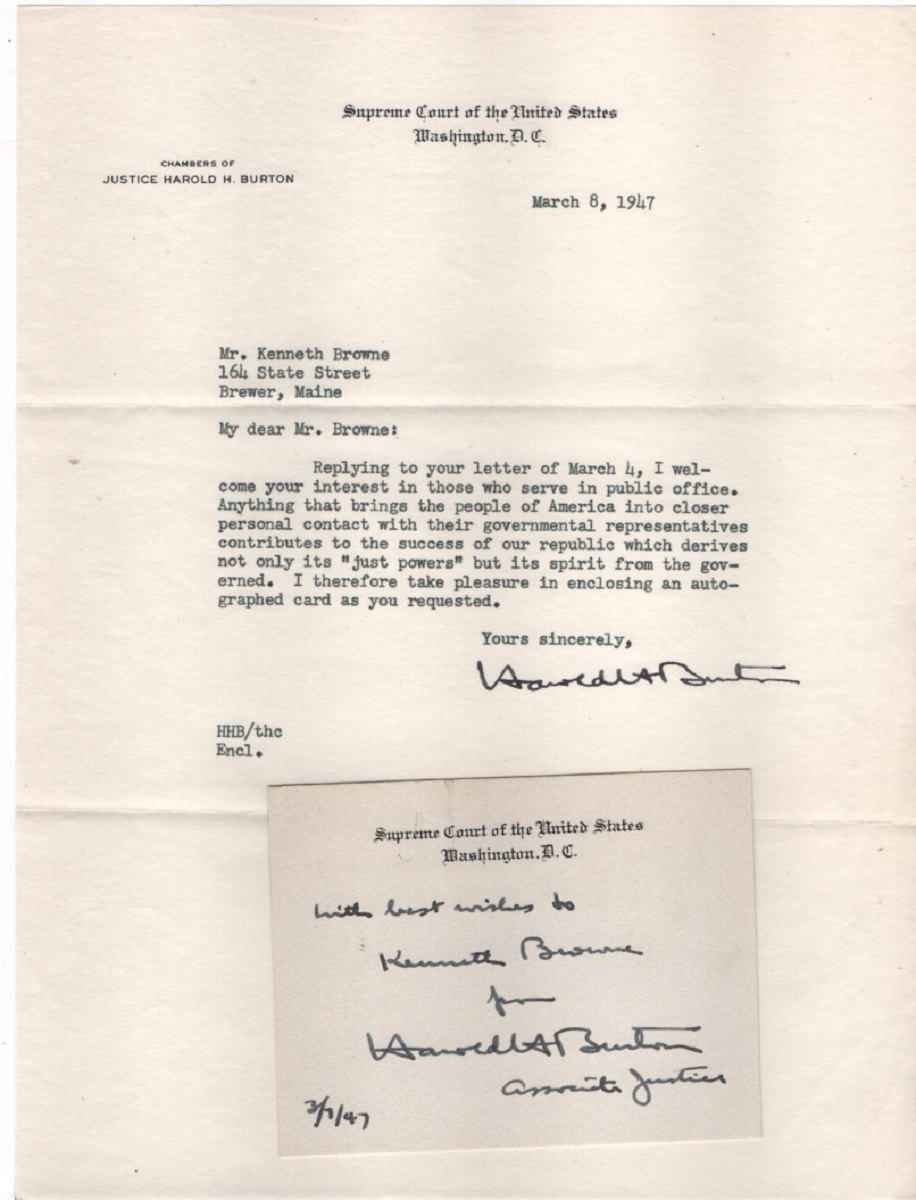
Signed letter, 4to, Washington DC, Feb. 15, 1947 Supreme Court stationary. Burton responds to a request from J. Duane Upton for his autograph and signs with a jet black signature “Harold H. Burton”. The letter is in very fine condition.
Burton was an active political figure from Ohio. He served three terms as Mayor of Cleveland and was then elected United States Senator. Although a prominent Republican, Burton was President Harry Truman’s first nominee to the Supreme Court. He replaced Justice Owen Roberts and when he resigned in 1958, due to ill health, he was replaced by Eisenhower appointee Potter Stewart.
[# 2047]
$75.00
|
|
Lincoln’s Chief Justice
Chief Justice (1864-1873)
Autograph letter signed, October 8, 1852, one page, Elyria, Ohio. Chase discusses a legal case with an unidentified correspondent. He squeezes his signature in at the bottom of the letter. The letter is in excellent condition and is a nice one page example from the Ohio politician who was one of Lincoln’s rivals for the presidency in 1860 and then went on to become Lincoln’s Treasury Secretary and then Chief Justice.
Chase was a Presidential nominee in 1860. After losing to Lincoln he was later asked to serve in the Civil War Cabinet as Treasury Secretary. While contributing significantly to the success of the war by raising necessary funds and keeping the government financially afloat we never quite lost the Presidential ambition. Lincoln nominated him as Chief Justice in 1864. Although he had a long career on the Supreme Court his most memorable role may have been as presiding Judge during the Impeachment Trial of Andrew Johnson.
[#2875]
$350.00
|
|
Good content on the ERA and Gay Rights
Associate Justice (1949-1967)
Autograph letter signed, March 23 (no year). Retired Justice Clark responds to some questions on both sides of a 4 1/2 x 3 1/4 Supreme Court card. Clark says he is in favor of the Equal Rights Amendments and then "2. Homosexuality ipso facto should not be a bar to employment."
Although writing on Supreme Court stationary he preceded his response with a disclaimer that he no longer sits on the Court: "do not speak for it; nor should my views be attributed to any member of the Court."
The proposed Equal Rights Amendment was, of course, promoted as a women's rights issue. Rarely debated or discussed during the 1970's, when this most likely would have been written, was the possible implications of the ERA beyond women's rights. Well ahead of his time, the former Justice succinctly summarizes the basis for today's gay rights debates: equal rights and the Equal Protection Clause, by definition, applies to homosexuals and extends to the right to marry. Clark's comments did not mention marriage but at the time this was written the debate over gay rights was in extending non-discrimination protection in the workplace.
Justices, even retired Justices, rarely offer opinions on controversial questions. It is rather remarkable that Clark would have risked being drawn into such a controversial issue at the time and then potentially inflamed the debate by linking it to something even more controversial at the time. Needless to say, the letter is noteworthy for being such an early reference to Gay Rights, even if only by a former Justice.
Clark was a politically active Texas attorney who joined FDR’s Administration. Although a federal appointee he was an active supporter of Harry Truman, who tapped Clark to be his Attorney General. Truman turned to Clark again in 1949, nominating to the Court following Justice Frank Murphy’s death. One of his major opinions for the Court was Mapp v. Ohio in 1961 which prohibited the use of evidence obtained illegally. Clark resigned from the Court soon after President Johnson appointed his son Ramsey to his former job of Attorney General. This created the vacancy that led to Johnson’s nomination of Thurgood Marshall as the nation’s first African-American Justice. [#1517]
$450.00
|
|
|
Uncommon in handwritten letters
Daniel, Peter
Supreme Court Justice (1841-1860)
Autograph letter signed, one page, April 11, 1839, to Sec. of the Navy. Daniel writes a very circumspect letter of introduction to James K. Paulding, Secretary of the Navy under Van Buren. While explaining that he knows the bearer for some time he doesn’t know him particularly well but has high regards for the other people who have written similar letters of introduction. This is almost a quaint example of how prominent figures handled the many requests for letters of introduction and recommendation from job seekers. What could be a more backhanded introduction and coded response than: “I have known him a long time but not well enough to recommend him. I place high regard in the other people who were forced to write letters and am joining the group”?
Daniel was a political Justice. He was appointed to the Court thanks to his political friends and while on the court he seemed to be guided by his early political beliefs rather than legal doctrine. Daniel chose his partners wisely. He studied law under Edmund Randolph, George Washington’s Attorney General and then married his daughter. As a local political activist he was a staunch supporter of Andrew Jackson who later appointed him a federal judge. In his own midnight appointment act, Martin Van Buren nominated Daniel to the Supreme Court one month before the end of his term to fill an unexpected vacancy. Daniel was rushed through the nominating process and approved by the Senate with just 36 hours left in Van Buren’s term.
Daniel’s autograph is tough to find and handwritten letters are quite scarce. [# 2877]
$750.00
|
|
Abraham Lincoln’s campaign manager
Associate Justice (1862-1877)
Autograph letter signed, Bloomington, IL, October 25, 1883, 8vo sheet. Davis responds to a request for his autograph from Mrs. Walter Hoge of the Ladies Aid Society: “with many thanks for your kind words I cheerfully comply with your request for my autograph by subscribing myself your friend and servant David Davis”. The folded sheet is lightly lined and displays the mailing folds, away from the signature. There is some ink blotch in the “is” of Davis. A very nice example of an important associate and friend of Lincoln.
David Davis was a close friend of Abraham Lincoln. Their relationship dates back to the mid 1830’s when they both practiced law in Illinois. Davis served in the Illinois Legislature as a Whig. Very active politically, Davis would ultimately be one of the key figures in Lincoln’s 1860 presidential campaign. Lincoln appointed his good friend and political ally to the Supreme Court in 1862. Davis served on the Court from 1862 until 1877 when he resigned to become U.S. Senator from Illinois. [# 2057]
$225.00SALE PENDING
|
|
Associate Justice (1882-1902)
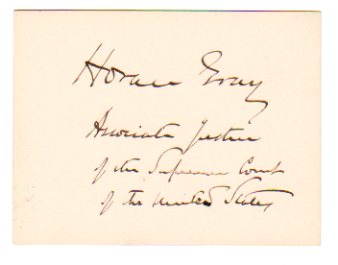
A blank card, measuring 4 ¼ x 3 ¼ boldly signed in a brown ink “Horace Gray Associate Justice of the Supreme Court of the United States.” Some slight age toning otherwise the card is in excellent condition with a perfect example of his signature and full title. [#2636]
Gray served as a Justice on the Massachusetts Supreme Judicial Court and then as its Chief Justice. He was appointed to the United States Supreme Court by President Chester Arthur and served there for twenty years, finally resigning after a stroke limited his work. He was replaced by a fellow Massachusetts Supreme Judicial Court Justice, Oliver Wendell Holmes.
[#2636]
$175.00
|
|
Associate Justice (1955-1971)
Autograph Letter Signed, 8vo, Washington, August 22, 1958 on Court stationary. Harlan responds to a collector with a handwritten note in jet black ink “I am pleased to send you this response to your request for my autograph. And signs in full “John Marshall Harlan”. The letter is in excellent condition with an old dealer’s price in pencil in the upper left corner.
Harlan was a mainstream establishment Republican from Illinois. Active in New York legal circles he was close to Thomas Dewey. Thanks to the mentoring of Eisenhower’s Attorney General Herbert Brownell, Harlan was groomed for and eventually appointed to the Court by Eisenhower to replace Justice Robert Jackson. Harlan would stay on the Court until 1971 when he retired. Harlan’s retirement opened the door for President Nixon’s appointment of William H. Rehnquist as the newest member of the Court. [#2048]
$150.00
|
|
Signed Supreme Court card
Chief Justice (1930-1941); Associate Justice (1910-1916)
Supreme Court card boldly signed “Charles E. Hughes.” The card measures 4 ¼ x 3 ½. There is some slight age toning to the card, otherwise in excellent condition.
Hughes had one of the more remarkable careers of any of the Justices on the Supreme Court. A reformer against corrupt politics and big business, Hughes was elected Governor of New York. He then served six years as an Associate Justice of the Supreme Court, appointed by President Taft. He resigned from the Court to run against President Woodrow Wilson in 1916. When Warren Harding became President, Hughes was pulled back from private practice into government serving as Secretary of State under both Harding and Coolidge. Herbert Hoover later appointed him Chief Justice, to replace William Howard Taft, the man who first appointed Hughes to the Court. He served as Chief Justice from 1930-1941.
(#1991)
$90.00
|
|
Supreme Court Justice (1881-1889)
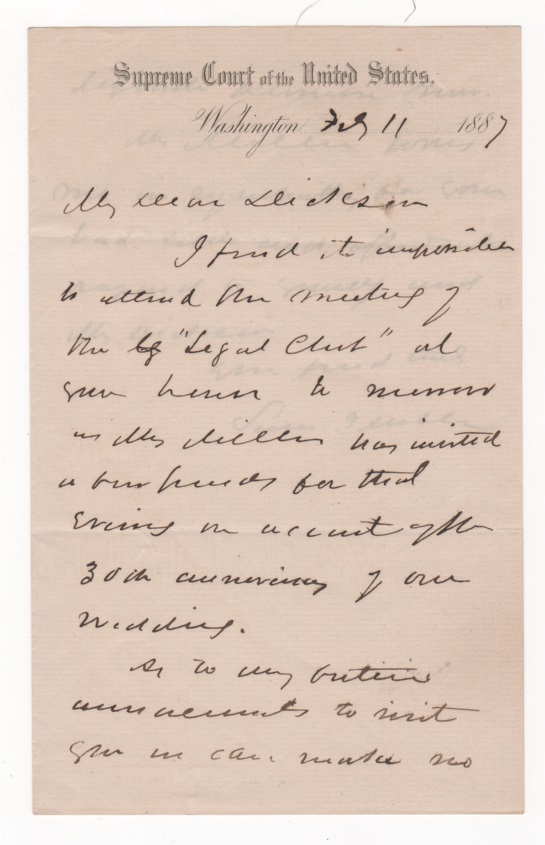
Autograph letter signed, Washington, Sept. 11, 1882, one page 8vo. Justice Matthews acknowledges but declines an invitation to be present and the Review of the Society of the Army of the Cumberland. [# 2849]
Matthews served with Rutherford B. Hayes during the Civil War and the two maintained their friendship through Hayes’ campaign. Matthews was nominated to the Court by Hayes but opposition stalled action and he was not confirmed. Garfield re-nominated him and he won confirmation by a single vote.
$250.00
|
|
Supreme Court Justice (1830-1861)
Autograph letter signed, one page, Washington, July 11, 1828. McLean asks a friend to guide some visitors to Baltimore. In part: his friends “ … are desiring of seeing what is worth seeing in the Monumental City. If your leisure will permit, I should esteem it a favour for you to point out to them the most interesting parts of the City.”
This is one of the earliest references to Baltimore as the “Monumental City”. In October the previous year President John Quincy Adams visited the city and had seen some of the monuments commemorating the defense of the City in the War of 1812. Apparently Adams was impressed by several of the monuments for at a dinner he toasted the city as “Baltimore, the Monumental City.” The name stuck, at least at the time. This is an interesting example of how the War of 1812, a comparatively forgotten War today, was an important symbol for the second and third generation Americans as their own war of Independence against Britain. Its significance was strong enough to make battle sites a tourist attraction. It is also a wonderful early example of patriotic marketing. A line from a Presidential toast is immediately seized upon by locals as a marketing tool to distinguish their city and helps draw visitors who want to see the monuments that were worthy enough to draw a visit from a President.
The letter is in fine condition with typical folds. The second sheet includes the address panel although the franking signature has been neatly removed—probably years later to provide some collector an uncommon autograph of the Supreme Court Justice.
McLean was politically active politician who served as Postmaster General under Presidents James Monroe and John Quincy Adams. Although a high official in Adams’ Administration he was supportive of Andrew Jackson who nominated him to the Court. While serving he quietly and ineffectively tried to position himself for the White House but only came as close as been nominated, with only token support, at the 1860 Republican convention. Although appointed by Jackson and strong States ’ Rights advocate he was opposed to slavery and along with Justice Benjamin Curtis were the only two votes against the Dred Scott decision.
This is accompanied by an antique engraving of McLean from the 1856 4 volume edition of the National Portrait Gallery of Distinguished Americans. [#2852]
$600.00
|
|
Lincoln appointment to the Supreme Court
Associate Justice (1861-1890)
A blank card signed “Sam. F. Miller Justice Supreme Court United States.” There is some slight age toning to the card and two small pin holes in the upper corners, otherwise in excellent condition. It measures 3 ¾ x 2 ½. This is a nice addition to a Supreme Court or Lincoln collection. .
Samuel Miller was an active Whig turned Republican activist in the 1860 election. A Lincoln supporter in Iowa, Miller was rewarded when Lincoln’s nominated him to the Court. A sympathizer of Lincoln’s struggle during the War, Miller upheld Lincoln’s suspension of habeas corpus and the right to try civilians by military tribunals. [#1876]
$150.00
|
|
|
Lincoln's appointee to the Supreme Court
Miller, Samuel
Autograph letter signed, two pages, 8vo, March 12, 1861. Miller writes a letter of introduction for a job applicant. The letter runs to the back of the first page, which would be the second of four pages on a folded sheet. It is in fine condition with minor notations in pencil on the front, possibly from a previous dealer.
Samuel Miller was an active Whig turned Republican activist in the 1860 election. A Lincoln supporter in Iowa, Miller was rewarded when Lincoln’s nominated him to the Court. A sympathizer of Lincoln’s struggle during the War, Miller upheld Lincoln’s suspension of habeas corpus and the right to try civilians by military tribunals.
[#2858]
$350.00
|
|
Congratulatory message for an election win
Associate Justice (1940-1949)
Autograph letter signed, one page, Supreme Court, May 8, 1941. Justice Murphy writes a personal note of congratulations to a friend who won an election. Noting that he doesn’t take sides in elections he can’t help but enjoy the satisfaction of watching an old friend win. Handwritten letters on Court Stationary are uncommon and this one is in excellent condition.
[# 2664]
Murphy was an active politician and close advisor to Franklin D. Roosevelt before taking a seat on the Supreme Court. His political base was in Michigan where he served one term as a reform Governor. His defeat for re-election opened the doors for his more prominent future. FDR brought him back to Washington, making him his Attorney General. One year later Roosevelt turned to him again to fill a vacancy on the Court, where he stayed until his death in 1949.
$150.00
|
|
|
Roger Taney
Chief Justice (1836- 1864)
Autograph document signed. January 13, 1811. This is a lower portion of a legal document "Lay down the land divided to Henry Browne by his father as the farm is now ___ and claimed by the said Henry Browne. January 13th 1911 R.B. Taney" The portion measures 8 1/4 x 2 1/2. [# 3053]
Taney, of course, is remembered for authoring the Supreme Court's opinion in the Dred Scott case. He began his career as a Federalist and political leader in Maryland
serving in both the House of Representatives and Senate but also established himself as a leading attorney. He would later serve as the State's Attorney General and become a Jacksonian Democrat. Jackson brought Taney into his Cabinet as Attorney General. In and odd piece of irony, Jackson first nominated Taney to be an Associate Justice but the nomination ran into trouble and was going nowhere. Later in that same year, Chief Justice Marshall died and Jackson again nominated Taney but this time as Chief Justice. The nomination was successful and Taney became one of the longest serving Justices in one of the most turbulent periods. His Dred Scott opinion helped inflame anti-slavery sentiment which led to Lincoln's election with Taney administering the Oath of Office to Lincoln in 1861. Taney would die before Lincoln's second Inauguration and Lincoln filled his vacancy with his Sec. of the Treasury Salmon P. Chase.
$150.00
|
|
Associate Justice (1892-1903)
Autographs quote signed, September 1898, Pittsburgh. Interesting quote signed. Written on stationary from the Duquesne Club in Pittsburgh, Shiras writes: “‘This lesson, reader, let us two decide, never to blend our pleasure or our pride, with sorrow of the meanest thing that feels.’ George Shiras Jr. Associate Justice of the Supreme Court of the U.S. September 1898.” The source of the quote is not known, but most likely it is not his work.
There is some ink transfer from his title and date when the paper was folded, but still an unusual piece in excellent condition. [#2857]
Schiras was an unlikely Justice. He was neither a sitting judge, politician, nor party activist. He was a prominent corporate attorney. He was appointed to the Court by President Benjamin Harrison to replace Joseph Bradley.
$250.00
|
|
Associate Justice (1811-1845)
Autograph letters signed, one page, 8vo, no place, March 31, 1845. Story writes to Professor Felton at Harvard requesting the address of someone in London. He signs in full “Joseph Story”. The back panel is addressed in Story’s hand to the Professor. The letters has typical mailing folds but is in fine condition. [#2866]
Story was a second generation patriot, someone who knew some of the early founders but was of the next generation to succeed them in shaping the nation. Story’s contribution was always in the law. He was appointed to the Court by Madison, after being turned down by his first three choices, in 1811. Even at a young age he was considered brilliant and a leading legal scholar. He worked closely with Chief Justice Marshall and in many ways serves as one of the bridges in shaping the Court between Washington’s original Court and the Civil War era court of Taney.
Much of the Court’s work in that period focused on commercial matters and the tension between state and federal dominance in defining the “united” states. Story was a leader in helping create federal dominance in commercial and economic matters and undercutting the power of states to regulate or interfere with interstate commerce.
$350.00
|
|
Rare single term Court signed by all nine Justices
Blackmun as newest Justice
Formal portrait by Ackard of the Supreme Court Justices, signed by all nine Justices. The color image measures 8 3/4 x 13 and is mounted to a larger 12 x 17 photographers mat. It has been signed by all nine on the white mat: John M. Harlan, Hugo Black, Warren Burger, W.O. Douglas, Wm. J. Brennan, Thurgood Marshall, Potter Stewart, Byron White, Harry A. Blackmun.
This is a very scarce Court that only served one full term. Harry Blackmun, the newest member, took his oath on June 6, 1970. He filled a vacancy that had existed for over one year when Abe Fortas resigned. President Nixon had trouble filling that vacancy as the Senate rejected two consecutive nominations opening the way for Blackmun on the third try. The Court would not stay together for long. One year later, in September 1971, both John Harlan and Hugo Black resigned. This group would have only been together for 15 months. However, Blackmun would not have taken part in any major decision in June before the summer break since he had not heard the oral arguments.
This group of nine only ruled on matters for the term which began in October 1970. Two of its most controversial decisions included the Pentagon Papers case (New York Times v. United States) where it ruled the government could not restrain publication of leaked secret documents. It also authorized school busing (Swann v. Charlotte-Mecklenburg Bd. of Ed.) as a means of integrated racially imbalanced schools.
The image and signatures are in excellent condition, with just a slight fading to Hugo Black's signature in blue ink. There is some bumping to the edges and what appears to be a few small remnants of a glue along the bottom on the mat from prior framing. These are insignificant and identified only for complete accuracy. The overall visual appearance is excellent and it would be hard to find another example of a signed photo by all nine Justices of this particular Court. [#3063]
$1,750.00
|
|
One of the Four Horsemen of the Court
Associate Justice (1922-1938)
An official Supreme Court Card 4 ½ x 3 ½” with a large signature and date “Geo Sutherland/ April 27/40” The card and signature are in excellent condition. [#2902]
Sutherland was both a prominent attorney and political figure in the Territory and State of Utah. A conservative Republican, Sutherland was appointed to the Supreme Court by President Warren Harding. Liberal on individual rights and conservative in regards to the powers of state regulation, he became a consistent opponent of Franklin Roosevelt’s New Deal legislation. Sutherland, along with Justices Pierce Butler, Willis VanDevanter and James McReynolds comprised the “Four Horsemen” of the Court who fought Roosevelt and led to FDR’s failed Court Packing plan.
$75.00
|
|
Taft feigns optimism about the pending election
27th President (1909-1913)
William H. Taft signed letter, Beverly, MA but on White House stationary, October 22, 1912. Taft thanks Dr. Fred Smith for a letter, probably related to the campaign and personal attacks he was taking from Theodore Roosevelt. In part: "It is a pleasure to receive such expressions of sympathy and confidence..." He concludes with "I am very hopeful as to the outcome!" Two weeks later, Taft would be blown out of the White House in a three-way contest, losing to both Woodrow Wilson and his predecessor and former friend Theodore Roosevelt. It is interesting that with only a few days left in the campaign Taft would be at his summer White House in Beverly. It is also tempting to read his carefully chosen words in another light. Taft hated being President and was ambivalent about re-election. Perhaps when he wrote he was "hopeful as to the outcome" he was indeed aware he had little chance.
The letter is in excellent condition and is accompanied by the White House envelope. [#3065]
$450.00
|
|
McKinley’s Attorney General and only Supreme Court nominee
Associate Justice (1910-1937)
Large formal signed portrait. The Clinedinst Studio head and shoulders portrait of Van Devanter, in his judicial robe, measures 6 x 9 and is on a larger photographer’s matting, which measures 9 ¼ x 13 ½ at sight as framed. Van Devanter has inscribed it on the matting “To Ernest Kraebel(?) with high regards and personal good wishes Willis Van Devanter June 11, 1919.” The impressive photo is elaborately framed in a double gold border with velour or velvet cover between the inner and outer gold frames. The overall dimensions are 17 x 21 ½. There are some nicks and loss of gold paint in places but still a very dramatic presentation of a formal portrait of an individual justice. [#2678]
Van Devanter was known as one of the Court’s Four Horsemen: conservative justices who actively opposed much of the New Deal Legislation leading FDR to try his Court Packing scheme in order to get friendlier justices on the Court. He was first appointed to the Federal Court of Appeals by President Theodore Roosevelt in 1903 and then to the Supreme Court by President William Howard Taft in 1910.
$750.00
|
|
Signed Check as Chief Justice
Chief Justice (1946-1953)
Fred Vinson signed check as Chief Justice. The check, made out on Sept. 28, 1949 is drawn on his personal account at The First National Bank in Louisa, KY is made out to the Chesapeake Ohio Railway for $33.13 for passage between Danville KY and Washington D.C. The 8 1/2 x 3 check is filled out in type and then personally signed in full by the Chief Justice "Fred M. Vinson". In excellent condition with cancellation marks well away from the dark signature. [#3193]
Vinson was an active Democrat politician rising through the ranks of local Kentucky politics and into the U.S. Congress. In appreciation for his Congressional support, and recognition of his legal skills, FDR appointed Vinson to the important Court of Appeals for the District of Columbia. He would resign that post six years later to head up some important war era boards for the president. Truman would later bring him into his Cabinet as Attorney General. Vinson was in that post for less than a year when Chief Justice Harlan Stone died. Infighting among the remaining justice over Stone's replacement prompted Truman to go outside the Court and nominate his Attorney General as the new Chief Justice, a position which Vinson would only hold for a few years until his death in 1953. Vinson was succeeded as Chief Justice by Eisenhower's nominee, Earl Warren.
$70.00
|
|
Chief Justice of the Supreme Court (1874-1888)
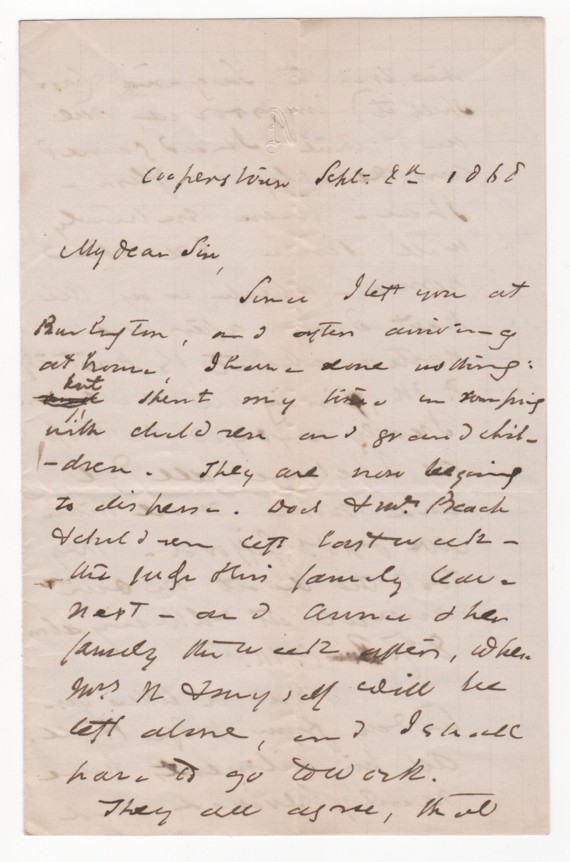
Autograph letter signed as Chief Justice. Dated October 10, 1876, Washington, the Chief Justice writes to a young autograph collector sending her a copy of a letter he wrote three years earlier to a Capt. Dorr. As evident in the letter the Captain had made the request on behalf of the collector directly to the Chief Justice. It is written in bold, dark ink. The 8vo sheet is neatly mounted at the left edge to a larger sheet, otherwise in excellent condition. (#1899)
$450.00
|
|
FDC signed by the Warren Court after Marshall’s appointment
1967-1969
Complete Warren Court signed on a 1968 cachet FDC honoring Justice Oliver Wendell Holmes. The cover was cancelled on March 8, 1968 in Washington. If is signed by Chief Justice Earl Warren and Associate Justices Thurgood Marshall, Hugo Black, William Douglas, Byron White, Abe Fortas, Potter Stewart, John M. Harlan and William Brennan. This would have been the Court of 1967-1969 when Thurgood Marshall joined as the junior Justice after being confirmed in August during the Court’s summer recess. Marshall replaced Truman’s appointee Tom Clark who resigned because Johnson appointed his son Ramsey as Attorney General. This Court lasted until May 14, 1969 when Abe Fortas resigned over a scandal involving questionable payments. The cover and signatures are in excellent condition. Pieces signed by an entire Court are very desirable and those of the Warren Court are particularly good investments for Court collectors. [# 2883]
$1,100.00
|
|
Governor Warren thanks a friend
Chief Justice, Governor of California
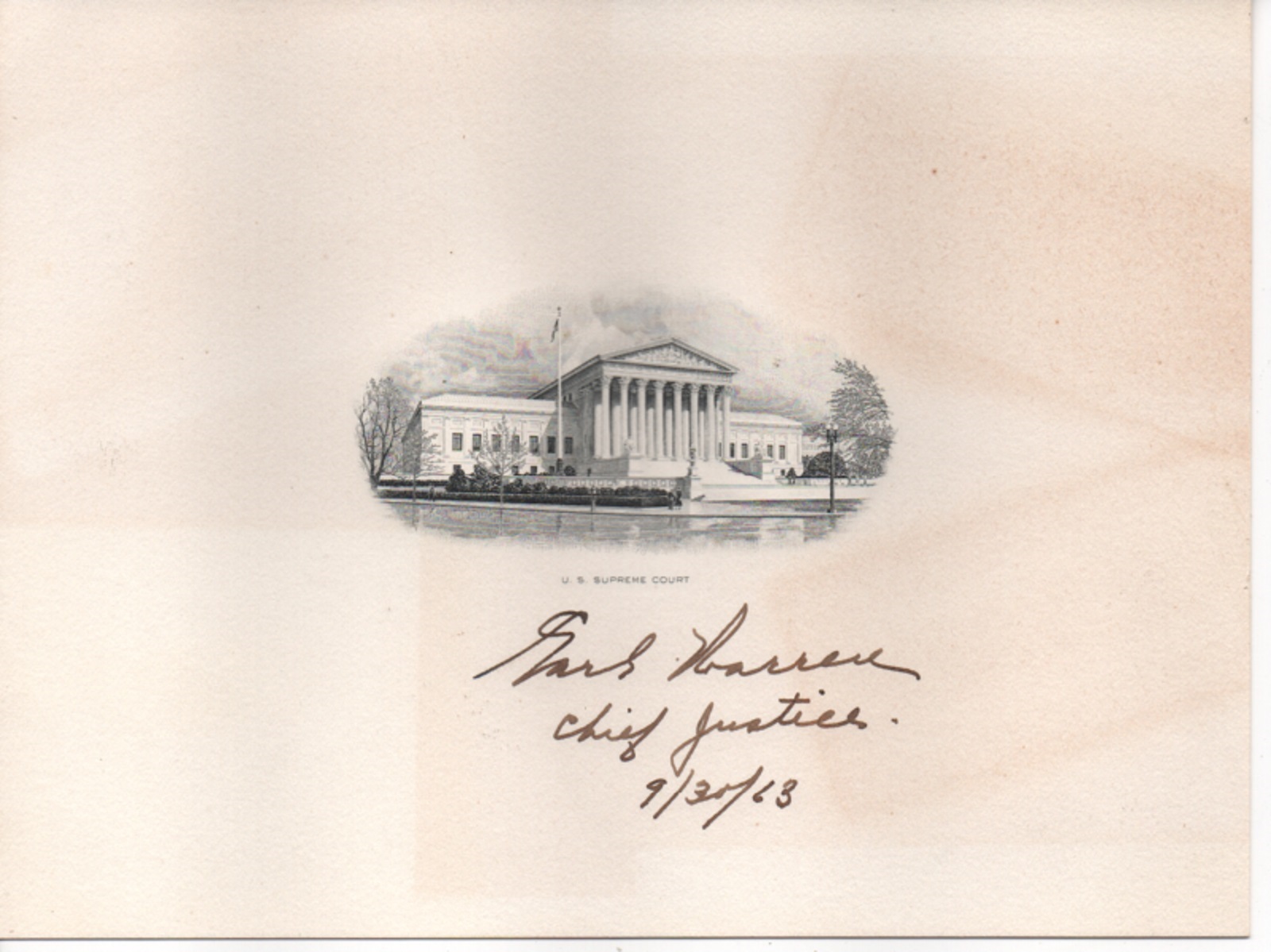
A friendly letter of thanks to a friend written on official “personal” stationary as Governor. The letter, dated December 22, 1950 thanking a friend for his congratulatory telegram after being re-elected Governor of California and mentions a medical crisis concerning his wife or daughter: “Mrs. Warren and I want to thanks your for your expression of sympathy over Nina’s illness. Fortunately, she is making an almost miraculous recovery, and the doctors tell us she will not suffer any permanent handicap.” Signed with his full signature “Earl Warren.” The letter has the gold seal of California. The letter has two typical mail folds, away from the signature. Fine condition. (#1246)
$100.00
|
|
Supreme Court Justice (1835-1867)
Autograph letter signed, one page, 4to, Savannah, June 18, 1819. Wayne writes to a potential out of state client that he was not getting any cooperation from one of the parties involved in his claim and therefore would not be able to proceed. The content is rather routine legal business but it is a very nice single page handwritten example of a scarce Justice. The writing is in heavy black ink and Wayne’s signature is especially good. The letter shows typical mailing folds which do not detract from it. There are three file punch holes on the left side with a slight loss of paper in the margin at the left center of the page.
Wayne served four in the House of Representatives from Georgia. There was nothing particularly brilliant about his political career other than loyalty to President Andrew Jackson. Loyalty, some prior experience as a state judge, and a southern base were enough to earn him Jackson’s nomination to the Supreme Court to replace another Southerner, William Johnson of South Carolina, who died. He was Jackson’s third of seven appointments and like two others, Roger Taney and John Catron, Wayne’s service as Justice would bridge the two climactic periods of Jackson’s presidency and the Civil War. A Southern slaveholder, he was an automatic vote for slaveholders’ interests but he was also a unionist who refused to resign his federal office when war broke out. Although he served on the Court for a long period of time he neither wrote many important decisions nor doe sit appear that he used his free time to write many letters. His signature is surprisingly uncommon and letters are scarce. [# 2881]
$500.00
|
|
Associate Justice (1962- 1993)
Signed photo. Harris and Ewing took this formal portrait which has a 5 x 7 printed image but measures to an overall size of 8 x 10 ¾. White has signed din full in the white border below his image “Byron R. White.” The photograph and signature are in excellent condition. [# 2674]
President John F. Kennedy appointed White to the Court. He served for more than 30 years from 1962 until his retirement in 1993. A one-time professional football player he was a friend and national organizer for John Kennedy’s presidential campaign. After a brief stint as Robert Kennedy’s Deputy Attorney General he was appointed to the Supreme Court.
$45.00
|
|
Confederate soldier and prisoner of war who became Chief Justice
Chief Justice (1910-1921)
Signed card, approximately 5 ¼ x 2 ¼, inscribed “Edward D. White Associate Justice. In fine condition.
White is one of the more colorful members of the Supreme Court. A native of Louisiana he fought for the confederacy, until taken prisoner by Union forces. After the war he became active in Southern politics and business, particularly the sugar interests, where his family’s fortunate originated. Even as a Justice and Chief Justice of the Court White blatantly protected the sugar industry. Appointed to the Supreme Court in 1894 by Democrat Grover Cleveland he later became the first Associate Justice to become Chief Justice through appointment by William Howard Taft. Ironically, Taft would later become Chief Justice by replacing his own nominee when White died in 1921.
[# 2601]
$100.00
|
|
Letter to the despised President of the Bank of the United States
Supreme Court Justice (1845-1851)
Signed letter, one page, Navy Department, February 27, 1834. Serving as Andrew Jackson’s Secretary of the Navy, Woodbury writes to Nicholas Biddle, President of the Bank of the United States sending $10,000 and directing that almost $8,100 is for bill associated with maintaining squadrons in the Mediterranean.
The letter has fine association of a major struggle of the Jackson Administration. Jackson strongly opposed a central bank and struggled to shut it down. He did this partly through vetoing a new charter for the bank and then by starving it of funds. Here, is Sec. of the Navy, sends payment for some bills but clearly had been holding onto funds outside of the bank. In this case it appears Woodbury was sending money only to settle some bills for the Navy and marines that were patrolling or stationed in the Mediterranean to protect American shipping interests. Later that year Woodbury was appointed Secretary of the Treasury to help advance Jackson’s fight against Biddle and the Bank of the United States. The letter and signature are in fine condition with some later reference notes in pencil in the lower right, apparently from a collector or dealer.
Woodbury served under Jackson as both Secretary of the Navy and Secretary of the Treasury. President Martin Van Buren appointed him to the Court, filling the vacancy of Joseph Story. He served a relatively brief tenure on the Court.
[#2630]
$175.00
|